finelybook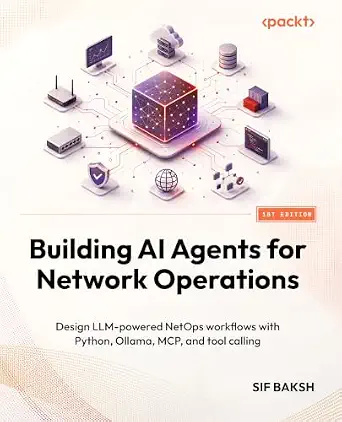
Building AI Agents for Network Operations: Design LLM-powered NetOps workflows with Python, Ollama, MCP, and tool calling
Author(s): Sif Baksh (Author)
- Publisher Finelybook 出版社: Packt Publishing
- Publication Date 出版日期: July 29, 2026
- Edition 版本: 1st
- Language 语言: English
- Print length 页数: 226 pages
- ISBN-10: 1808346831
- ISBN-13: 9781808346835
Book Description
Build AI-assisted network troubleshooting workflows that parse CLI output, call approved tools, use MCP, and keep evidence visible for review
Key Features
- Build local LLM workflows for NetOps using Python, Ollama, and validated CLI data
- Create troubleshooting agents that use memory, approved tools, and clear evidence
- Package reusable network tools with MCP and plan controlled read-only pilots
Book Description
Network troubleshooting is full of clues, but they are often buried in noisy alerts, long CLI output, missing topology context, and incomplete handoffs. Building AI Agents for Network Operations shows how to use AI agents, LLMs, and network automation in a controlled way, so engineers can get clearer evidence without giving up validation or operational control.
You will start with local LLM workflows using Ollama and Python, then use a simple RACE prompt structure to make repeatable NetOps tasks clearer, safer, and easier to review. You will parse interface and BGP output into structured data, build a chatbot that keeps troubleshooting context, and connect the model to approved tools for device status, interfaces, reachability, topology, and BGP health. You will then build an agentic troubleshooting loop, package reusable network tools with MCP, and learn how to evaluate these workflows against logging, approvals, observability, runbooks, feature flags, and read-only pilot readiness.
By the end of this book, you will have a practical path for turning AI ideas into NetOps workflows that can be tested in a lab, reviewed by your team, and adapted toward real-world network operations with the right controls.
What you will learn
- Run local LLM workflows with Ollama and Python
- Shape reliable NetOps prompts using RACE
- Parse CLI and BGP output into structured JSON
- Build chatbots that remember troubleshooting context
- Connect AI agents to approved network tools
- Create evidence-based troubleshooting loops
- Expose reusable network tools with MCP
- Plan read-only pilots with safety controls
Who this book is for
This book is for network engineers, NetOps engineers, NOC engineers, SREs, DevOps engineers, and network automation professionals who want to apply AI to troubleshooting without losing control. Basic networking and CLI familiarity will help, beginner Python knowledge is useful for following the labs.
Table of Contents
- Understanding AI Agents for Network Operations
- LLM Fundamentals and Local Setup
- Prompt Engineering for Network Automation
- Parsing Network Outputs into Structured Data
- Building a Network Chatbot with Memory
- Designing Tools and Agentic Workflows
- Building the Main Network Troubleshooting Agent
- From Lab Agents to Reusable Tools with MCP
- Moving Toward Production-Ready Network Agents
Editorial Reviews
Editorial Reviews
About the Author
Sif Baksh is a network automation architect, solutions engineer, and technical educator with more than 15 years of experience across networking, security, infrastructure, and automation. His work focuses on helping engineering teams build governed workflows that connect network data, infrastructure APIs, operational tools, and human approvals into systems that are practical, observable, and safe to operate. His technical background includes DNS/DHCP/IPAM automation, network and security operations, threat intelligence enrichment, compliance workflows, incident response, and tool integration. He has worked with teams to replace manual, ticket-driven processes with repeatable automation patterns designed for production environments. His current work explores how AI agents, local LLMs, prompt design, tool calling, MCP servers, and agentic troubleshooting loops can be applied to network operations without losing validation or control. Through his writing, workshops, videos, and community projects, he teaches engineers how to turn AI ideas into NetOps workflows that can be tested, reviewed, and trusted.