finelybook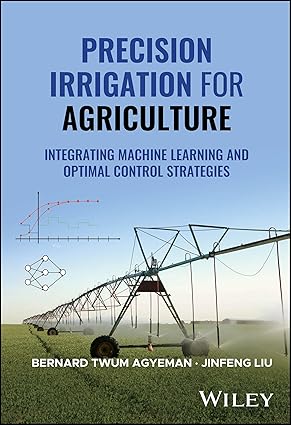
Precision Irrigation for Agriculture: Integrating Machine Learning and Optimal Control Strategies
Author(s): Bernard Twum Agyeman (Author), Jinfeng Liu (Author)
- Publisher finelybook 出版社: Wiley
- Publication Date 出版日期: May 11, 2026
- Edition 版本: 1st
- Language 语言: English
- Print length 页数: 208 pages
- ISBN-10: 1394288522
- ISBN-13: 9781394288526
Book Description
Advanced methodologies in machine learning, optimal control, and agricultural water management to address irrigation scheduling in large-scale agriculture
Through a multidisciplinary approach, Precision Irrigation for Agriculture presents rigorous and practical methods that integrate machine learning, optimal control, and agricultural water management to design irrigation schedulers tailored for large-scale agricultural fields. The book includes case studies and comparative studies, bridging the gap between theory and real-world application.
The book begins with a thorough review of existing irrigation scheduling practices and recent advancements in the field, then proceeds to examine the application of machine learning methods and optimal control strategies to address various challenges in irrigation scheduling.
The central focus of the book is the development of a novel irrigation scheduler. This novel scheduler unifies model predictive control with three machine learning paradigms―supervised, unsupervised, and reinforcement learning―into a cohesive framework specifically designed for the daily irrigation scheduling problem in large-scale agricultural fields.
The book also presents a computationally efficient methodology that leverages remote sensing observations to estimate soil moisture content and soil hydraulic parameters, which are key elements in the design of precise irrigation schedulers.
Written by a team of qualified academics, Precision Irrigation for Agriculture includes information on:
- Soil moisture modeling, including water content, energy status of soil water, the soil water retention curve, Darcy’s law, and the Richards’ equation
- Model predictive control and its application in irrigation scheduling, covering problem formulation, feasibility, solution techniques, and controller tuning
- Parameter selection and state estimation, including sensitivity analysis for parameter identifiability, the orthogonal projection method for parameter selection, and extended Kalman filter for simultaneous state and parameter estimation
- Multi-agent reinforcement learning for irrigation scheduling, including the integration of decentralized actor–critic agents, the limiting management zone concept, and model predictive control (MPC) to form a multi-agent MPC paradigm for irrigation scheduling; a semi-centralized multi-agent reinforcement learning framework to further refine irrigation timing decisions; and agent design, testing, and comparative studies against traditional irrigation scheduling schemes.
Precision Irrigation for Agriculture is a valuable resource for researchers in process control and irrigation management, irrigation practitioners, and students of agriculture, water management, machine learning, and optimal control.
From the Back Cover
Advanced methodologies in machine learning, optimal control, and agricultural water management to address irrigation scheduling in large-scale agriculture
Through a multidisciplinary approach, Precision Irrigation for Agriculture presents rigorous and practical methods that integrate machine learning, optimal control, and agricultural water management to design irrigation schedulers tailored for large-scale agricultural fields. The book includes case studies and comparative studies, bridging the gap between theory and real-world application.
The book begins with a thorough review of existing irrigation scheduling practices and recent advancements in the field, then proceeds to examine the application of machine learning methods and optimal control strategies to address various challenges in irrigation scheduling.
The central focus of the book is the development of a novel irrigation scheduler. This novel scheduler unifies model predictive control with three machine learning paradigms―supervised, unsupervised, and reinforcement learning―into a cohesive framework specifically designed for the daily irrigation scheduling problem in large-scale agricultural fields.
The book also presents a computationally efficient methodology that leverages remote sensing observations to estimate soil moisture content and soil hydraulic parameters, which are key elements in the design of precise irrigation schedulers.
Written by a team of qualified academics, Precision Irrigation for Agriculture includes information on:
- Soil moisture modeling, including water content, energy status of soil water, the soil water retention curve, Darcy’s law, and the Richards’ equation
- Model predictive control and its application in irrigation scheduling, covering problem formulation, feasibility, solution techniques, and controller tuning
- Parameter selection and state estimation, including sensitivity analysis for parameter identifiability, the orthogonal projection method for parameter selection, and extended Kalman filter for simultaneous state and parameter estimation
- Multi-agent reinforcement learning for irrigation scheduling, including the integration of decentralized actor–critic agents, the limiting management zone concept, and model predictive control (MPC) to form a multi-agent MPC paradigm for irrigation scheduling; a semi-centralized multi-agent reinforcement learning framework to further refine irrigation timing decisions; and agent design, testing, and comparative studies against traditional irrigation scheduling schemes.
Precision Irrigation for Agriculture is a valuable resource for researchers in process control and irrigation management, irrigation practitioners, and students of agriculture, water management, machine learning, and optimal control.
About the Author
BERNARD TWUM AGYEMAN, Postdoctoral Associate, Department of Chemical Engineering and Materials Science, University of Minnesota, Minneapolis, USA. His current research explores the use of reinforcement learning and graph-based techniques to solve mixed-integer optimization problems. His PhD research focused on employing machine learning, optimal control, and estimation methods to develop precise irrigation scheduling algorithms.
JINFENG LIU, Professor, Chemical and Materials Engineering Department, University of Alberta, Edmonton, Canada. He currently serves as the editor-in-chief for the IChemE journal Digital Chemical Engineering and holds roles as an associate editor for several other journals.