finelybook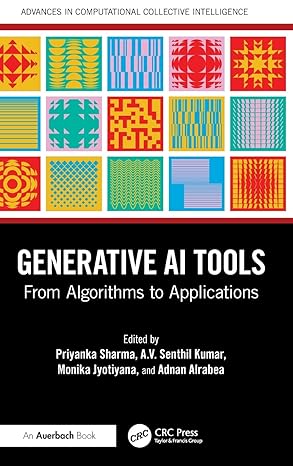
Generative AI Tools: From Algorithms to Applications (Advances in Computational Collective Intelligence)
Author(s): Priyanka Sharma (Editor), A.V. Senthil Kumar (Editor), Monika Jyotiyana (Editor), Adnan Alrabea (Editor)
- Publisher finelybook 出版社: Auerbach Publications
- Publication Date 出版日期: April 9, 2026
- Edition 版本: 1st
- Language 语言: English
- Print length 页数: 248 pages
- ISBN-10: 1032745908
- ISBN-13: 9781032745909
Book Description
Generative AI algorithms have become transformative forces in today’s digital landscape, revolutionizing industries from healthcare and finance to creative arts and software development by enabling machines to create human-like content, automate complex tasks, and generate innovative solutions at unprecedented scale and speed. These applications are driving significant productivity gains across organizations, with AI-powered tools like large language models, image generators, and code assistants helping professionals streamline workflows, enhance creativity, and solve problems that were previously time-intensive or required specialized expertise. The strategic importance of Generative AI extends beyond operational efficiency, as it represents a fundamental shift toward intelligent automation that is reshaping competitive advantages, creating new business models, and establishing AI literacy as a critical skill for future workforce success. Generative AI Tools: From Algorithms to Applications is a reference for researchers that consolidates rapidly evolving methodologies, theoretical foundations, and practical implementations. Highlights include:
- Generative AI tools and the marketing industry
- A comprehensive overview of ChatGPT
- ChatGPT integration in IoT ecosystems
Providing a structured framework for understanding this complex and fast-moving field, the book enables researchers to build upon established knowledge more efficiently, avoid redundant work, and identify promising research directions by offering systematic coverage of current state-of-the-art techniques, their limitations, and emerging challenges that require innovative solutions. Bridging the gap between theoretical concepts and real-world applications, the book helps researchers understand not only how these algorithms work but also their practical implications, ethical considerations, and potential societal impacts, which is crucial for developing responsible and impactful AI research agendas.
About the Author
Priyanka Sharma is recognized as being among the top 2% of scientists across the world, as declared by Stanford University and Elsevier. She is an active researcher, working as an assistant professor in the Department of Computer Science & Engineering, Swami Keshvanand Institute of Technology, Management & Gramothan, Jaipur, Rajasthan, India. She has guided various both undergraduate and postgraduate scholars. She is a member of the Institute of Electrical and Electronics Engineers (IEEE), the Association for Computing Machinery (ACM) and various professional societies. She has published more than forty research papers in national and international journals/conferences and book chapters, and has also edited four books. She has taken part in forums hosted by Infosys, TCS, Oracle, Wipro and IBM. Her particular area of interest is investigating the advancements in machine learning and deep learning applications. She has received accolades a number of times in a variety of fields, including designation as an active reviewer by some well-known journals.
Monika Jyotiyana is currently working as assistant professor in the Department of Computer Applications, Manipal University Jaipur, Rajasthan, India. She received her Doctoral degree and Master’s degree from Central University of Rajasthan, Rajasthan, India. She received her Undergraduate degree in 2010 from the Aryan International College Affiliated from the MDS University Ajmer, Rajasthan, India. Her research interests include medical image processing, machine learning, deep learning and neural networks. She has publications in various prestigious conferences, journals, books and book chapters.
A. V. Senthil Kumar is working as the principal of the Nehru Institute of Information Technology and Management, Coimbatore, India. He has worked as professor and director at the PG and Research Department of Computer Applications, Hindusthan College of Arts & Science, Coimbatore, Tamilnadu for more than 15 years and as a senior grade lecturer in CMS College of Science and Commerce for 14 years. To his credit, he has five years of industrial experience and three decades of teaching experience. He has also received his Doctor of Science (DSc. in Computer Science). He has to his credit 86 book chapters, 234 papers in international and national journals, and 85 papers in international and national conferences; he has also edited 17 books and 3 textbooks. He is an associate editor of IEEE Access and an editor-in-chief for many journals and a key member for India, Machine Intelligence Research Lab (MIR Labs). An editorial board member and reviewer for various international journals, he is also a committee member for various international conferences. To date, he has guided 16 PhD scholars; at present, he is guiding another 3.
Adnan Alrabea received his Dr. Eng. degree in 2004 from the Electronic and Communication Department, Faculty of Engineering, Donetsk University, Ukraine. He is a visiting associate professor and assistant dean of Prince Abdullah Bin Ghazi Faculty of Science and Information Technology at Al-Balqa Applied University, Assalt, Jordan. His research interests cover: analyzing the various types of analytic and discrete event simulation techniques; performance evaluation of communication networks; application of intelligent techniques in managing computer communication networks; and performing comparative studies between various policies and strategies of routing, congestion control, sub netting of computer communication networks. He has published around 30 articles in various refereed international journals and conferences covering: computer networks, expert systems, software agents, e-learning, image processing, wireless sensor networks and pattern recognition.